
Entry
7 Top AI Autoblogging Tools for Smarter Keyword Research
Most bloggers pick keywords by gut feel and then wonder why traffic flatlines. Many platforms bundle keyword research and AI writing into one subscription, yet some tools still leave you stitching together three dashboards just to plan a single post. That friction is usually what pushes people to look for alternatives.
This article breaks down seven AI autoblogging tools on keyword data sources, SERP analysis, and content output, so you can match one to your budget and workflow. It also names a clear overall pick and shows what to check before you commit.
What to Look For in AI Autoblogging Tools for Keyword Research
When evaluating AI autoblogging tools for keyword research, you need to look beyond surface-level features and assess how they integrate keyword data, SERP analysis, and content generation into a seamless workflow.
Many tools advertise "AI-powered keyword research" but deliver very different levels of depth. Some simply pull a list of related terms. Others map search intent, analyze competing pages, and then write content built around that intelligence.
Three core pillars separate a genuinely useful tool from a surface-level one: keyword data sources, SERP analysis depth, and content output quality. Each pillar plays a distinct role in whether your automated blog posts actually rank or just fill space.
Strong keyword data tells you what people search for and how hard it is to compete. Deep SERP analysis reveals what already ranks and why. Quality content output turns that intelligence into readable, optimized articles. Skip any one of these and the workflow breaks down.
The sections below break down each pillar so you can compare tools with a clear framework.
Keyword Data Sources, SERP Analysis, and Content Output
First, examine where the tool pulls its keyword data from, whether it's Google Keyword Planner, Ahrefs, SEMrush, or proprietary databases, and how it handles search volume, keyword difficulty, and cost-per-click metrics.
The source matters because it determines accuracy and freshness. Google Keyword Planner offers official search volume ranges. Third-party databases like Ahrefs and SEMrush often provide more granular difficulty scores and competitor data. Tools using proprietary databases may offer unique angles but can lack transparency.
Beyond the source, check which metrics the tool surfaces and how it presents them:
- Search volume: shows demand and helps prioritize topics
- Keyword difficulty: estimates how hard it is to rank on page one
- Cost-per-click: signals commercial intent and ad competition
- Long-tail keyword suggestions: captures specific, lower-competition queries
- Topic clustering: groups related terms into pillar pages and supporting content
Metrics alone don't tell the full story. A keyword with high volume but vague search intent can waste resources. Tools that classify intent, informational, transactional, navigational, or commercial, help you match content type to query type.
SERP analysis is the second pillar. A capable tool examines the top-ranking pages for a keyword and identifies patterns: content format, word count, heading structure, featured snippets, and People Also Ask questions. This reveals what Google rewards for that query.
Competitor gap analysis takes it further. By comparing your existing content against ranking pages, the tool can flag missing subtopics, weak semantic analysis coverage, and untapped backlink opportunities. Some platforms use natural language processing and machine learning algorithms to surface these gaps automatically.
The third pillar is content output. Tools vary widely here. Some generate full long-form articles. Others produce outlines, meta descriptions, or section drafts. The best options handle SEO writing assistant functions too: keyword density checks, readability scoring, internal linking suggestions, and heading optimization.
Match output type to your use case:
- Long-form guides: need full article generation with proper heading hierarchy and semantic keyword coverage
- Product pages: benefit from concise, conversion-focused copy with commercial keywords
- Pillar pages: require topic clustering and internal linking to supporting posts
- Meta descriptions and titles: short-form outputs that directly affect click-through rate
Tools built on GPT-3, GPT-4, or the OpenAI API tend to produce more natural prose, while older template-based generators can sound repetitive. Platforms like Jasper AI, Surfer SEO, Frase, MarketMuse, Article Forge, ContentBot, Writesonic, and Copy.ai each approach these three pillars differently. Some lean toward research, others toward writing.
When comparing options, score each tool on all three pillars. A tool strong in keyword data but weak in content output creates extra work. A tool with great writing but shallow SERP analysis misses ranking opportunities. The strongest AI autoblogging tools connect all three into one workflow, from niche targeting and keyword discovery through to published, optimized posts.
1. Autoblogging.ai - Best Overall
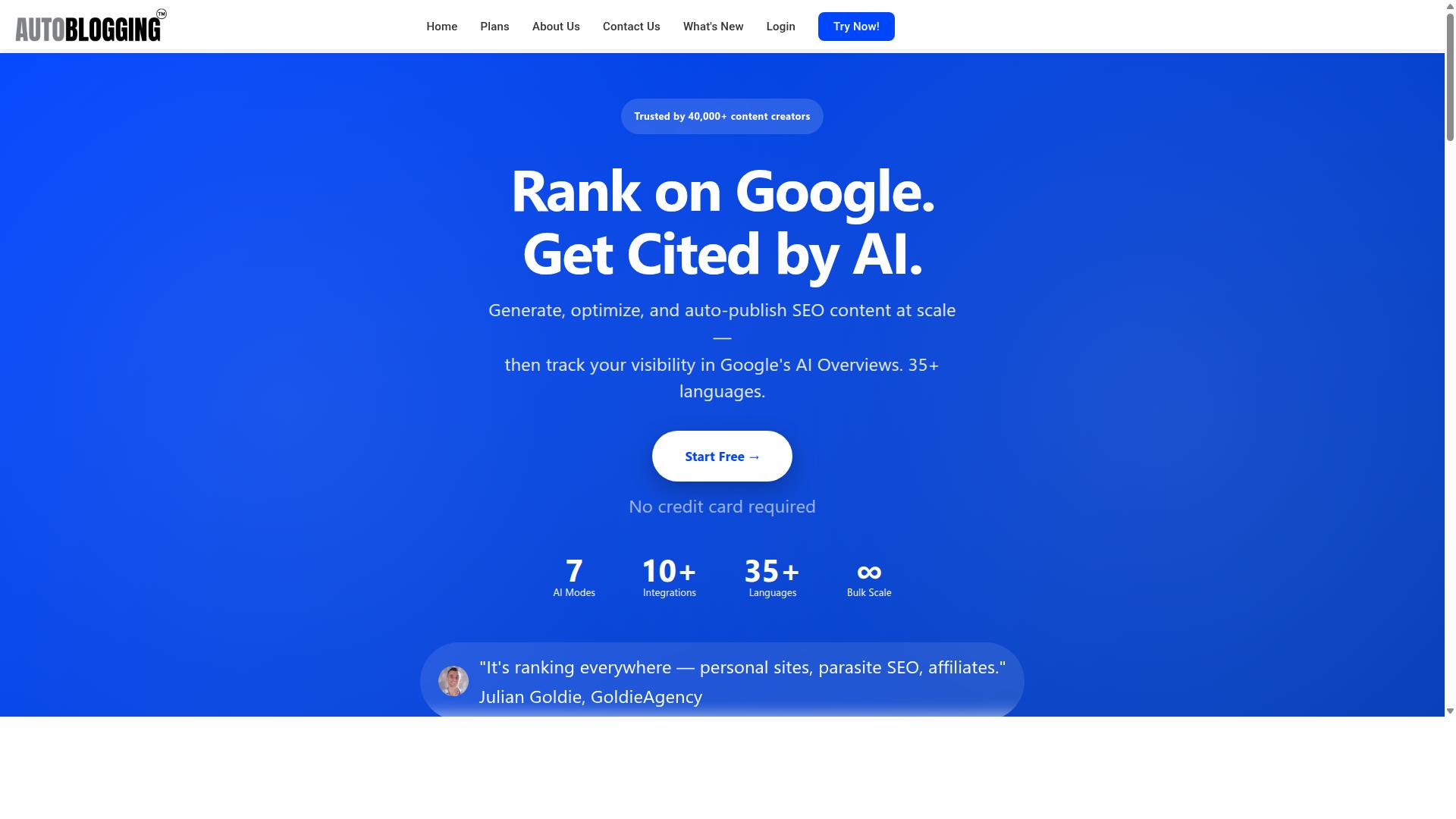
Autoblogging.ai earns our top recommendation for AI-powered keyword research and content generation, thanks to its robust feature set, competitive pricing, and proven track record with over 40,000 users.
What separates it from most tools in this category is the way research and writing live in one place. Many platforms handle keyword discovery well but hand you off to a separate writer. Others generate fluent text but leave you guessing which terms to target. Autoblogging.ai connects both halves of the workflow, so SERP analysis feeds directly into content generation rather than sitting in a separate dashboard.
The numbers back up the positioning. A 4.9 average rating across a user base of 40,000+ content creators, plus more than 1M articles generated, suggests the platform holds up under real publishing schedules. Credits roll over, which matters for anyone whose output varies month to month.
Beyond raw generation, the platform ships 10+ AI modes, supports 35+ languages, and connects with 35+ integrations. New features arrive weekly, and every plan includes a human proofreader alongside the AI one. For teams weighing AI autoblogging tools, that combination of breadth and editorial backup is uncommon at this price level.
Keyword Research Features, Pricing, and Who It's For
Autoblogging.ai's keyword research capabilities are powered by its Godlike Mode, which performs SERP competitor analysis, extracts LSI keywords, and builds knowledge graphs to identify content gaps.
Those four elements work together rather than as isolated reports. SERP competitor analysis shows what already ranks for a target query. LSI keyword extraction surfaces the related terms that signal topical relevance to search engines. Knowledge graph extraction maps entities and their relationships, which supports semantic analysis instead of simple string matching. Competitor gap analysis then highlights where rivals cover ground you have not.
The output feeds straight into generation. Because the research step identifies long-tail keywords, search intent, and topic clustering opportunities, the writing step starts from a brief rather than a blank page. That is the core argument for pairing keyword research with content automation in one subscription.
Pricing runs from Starter at $19 up to Enterprise at $999, with credits that roll over between billing periods. Publishing is handled through one-click WordPress integration for unlimited sites, plus Web 2.0 platforms like Medium, Dev.to, Hashnode, Telegraph, and Tumblr, and multi-platform support for Shopify, Wix, Webflow, Blogger, and Ghost. An API, Zapier, and n8n cover custom workflows.
The audience fits three main groups:
- Bloggers who need consistent automated blog posts without assembling a stack of separate subscriptions
- Agencies managing multiple client sites and publishing schedules
- Affiliate marketers targeting niche keywords where keyword difficulty and search volume drive the strategy
Optimization tools extend past drafting. A 21-point SEO audit, Snippet Optimizer, Topical Maps, Fan Out Queries, and internal linking support help turn published posts into assets that compete for organic traffic and featured snippets. Done For You packages exist for teams that want the output handled end to end.
2. Scalenut

Scalenut combines keyword research with AI writing, offering a suite of tools for SEO content creation. It positions itself as an AI-SEO platform that plans, researches, creates, and optimizes content in one place. For teams juggling separate tools for keyword planning and drafting, that all-in-one approach can reduce friction in the content workflow.
The platform is built around keyword planning and topic research, giving users a starting point before a single sentence is drafted. It also supports content optimization, so writers can refine drafts against SEO signals rather than guessing at what search engines want. These pieces work together rather than as isolated features.
Scalenut's feature set extends beyond standard keyword tools. According to public information, the platform includes:
- AI drafting and content optimization
- Keyword planning and topic research
- GEO tracking and AI visibility tracking
- Prompt insights and citation tracking
- AI traffic signals
- A GEO Action Center
- Social Upreach
- A Backlinks Marketplace
The inclusion of AI visibility tracking and citation tracking reflects a growing interest in how content surfaces inside AI-generated answers, not just traditional search results. That makes Scalenut relevant for marketers thinking beyond classic SERP rankings.
On the content generation side, Scalenut leans on natural language processing and machine learning algorithms to turn research inputs into draft material. Writers can then optimize those drafts using the platform's built-in SEO guidance. The goal is a tighter loop between keyword research, content generation, and optimization.
Scalenut appears aimed at SEO teams, marketers, and agencies focused on SEO and GEO content workflows. Its range of features suggests it suits users who want research and writing handled within one subscription rather than stitched together from multiple vendors. Solo bloggers may find some advanced features beyond their needs.
Pricing details are not stated in the public sources reviewed here, so readers should check the official site for current plans. The pages do mention a free course, free tools, and a free AI audit, which offer a low-risk way to explore the platform before committing. Those free resources can help evaluate fit without a paid trial.
For keyword research specifically, Scalenut's strength lies in connecting research directly to drafting and optimization. That reduces the handoff between an SEO specialist and a writer, which is often where search intent and long-tail keyword targets get lost. Teams that value that continuity may find it a practical option to evaluate alongside other AI autoblogging tools.
3. RankYak
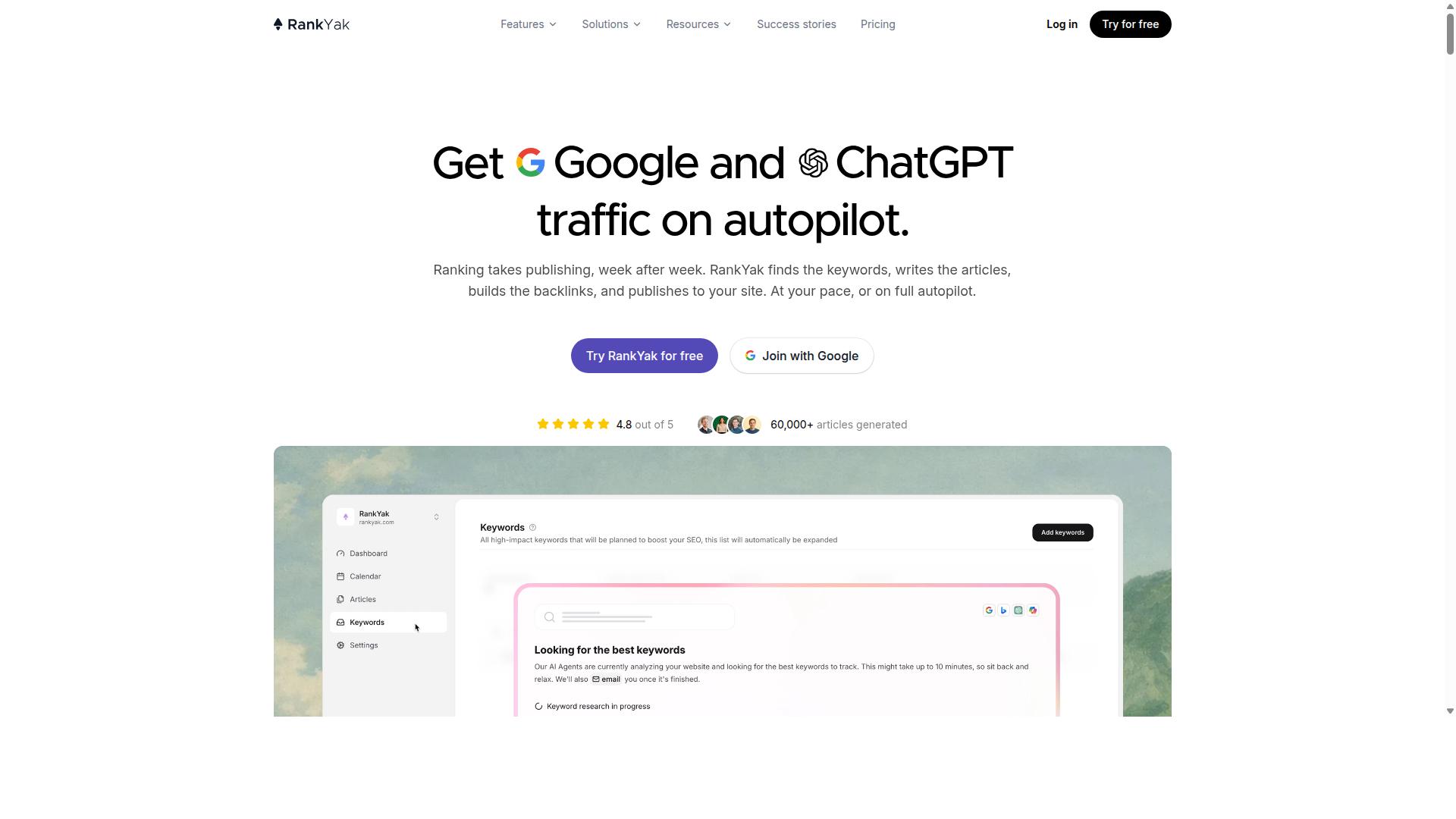
RankYak focuses on automating the entire content pipeline, from keyword discovery to publishing. It positions itself as an SEO automation platform rather than a single-purpose writing tool, which makes it a relevant option for teams that want keyword research and content generation handled in one place.
The platform bundles several functions that usually live in separate subscriptions. These include keyword discovery, a content plan, article generation, and a tool called Site Guard that finds and fixes pages losing clicks. A backlink exchange feature and a Copilot assistant round out the offering.
For readers comparing AI autoblogging tools, that breadth is RankYak's main selling point. Instead of moving between a keyword tool, an SEO writing assistant, and a publishing plugin, users work inside a single dashboard. The tradeoff is that each individual module may not match the depth of a dedicated specialist tool.
RankYak states that users can generate a first article within about 15 minutes of starting, and a free trial is available. Pricing details are not published on the pages reviewed for this roundup, so anyone evaluating cost should confirm current plans directly with the vendor.
The platform lists solutions for agencies, SaaS companies, ecommerce stores, startups, and local businesses. That range suggests it is aimed at teams producing content at volume rather than individual bloggers publishing occasionally.
- Keyword discovery to seed topic ideas and content plans
- Article generation built on top of that keyword data
- Site Guard for recovering pages that are losing clicks
- Backlink exchange to support off-page visibility
- Copilot and MCP server for assisted workflows and integrations
In practice, RankYak fits best when content automation needs to run across many pages or multiple client accounts. An agency managing several niche sites, for example, could use the content plan to map long-tail keywords and then push generated drafts toward publishing.
Its Site Guard feature is worth noting because it addresses a problem most autoblogging tools ignore: existing content that slowly loses rankings. Combining new content generation with refresh suggestions is a more complete take on search engine optimization than writing alone.
RankYak is a credible mid-tier choice for teams that value an all-in-one workflow. It is less suited to writers who want fine-grained control over every sentence, since automation-first platforms tend to trade editorial precision for speed.
4. theStacc
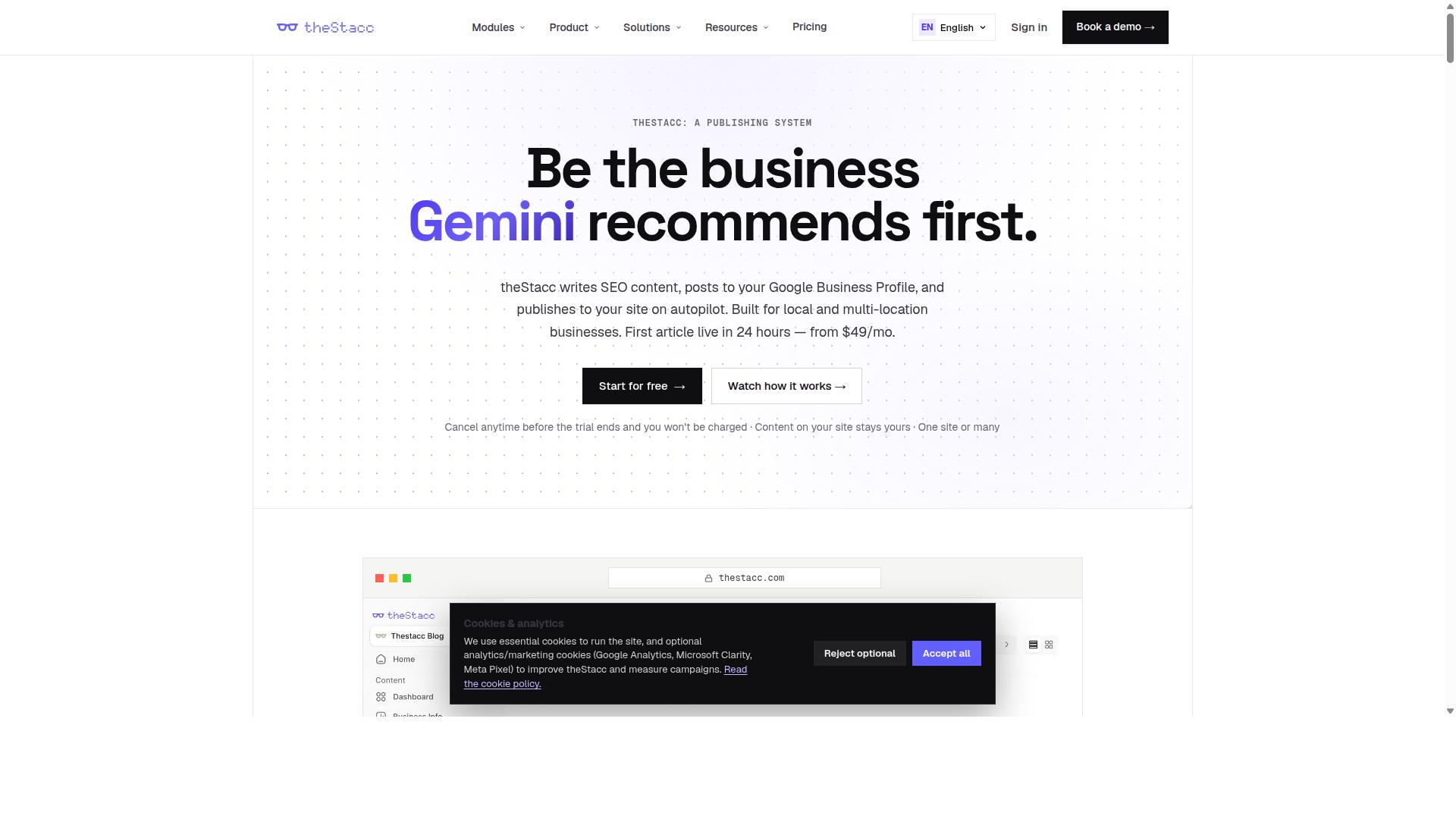
theStacc is a lesser-known AI tool that emphasizes keyword-driven content creation for niche sites. It is built as a broader SEO platform rather than a single-purpose writer, which means keyword strategy and publishing sit inside the same workspace as local and social modules.
For teams that want keyword research and content production to live in one place, that structure can reduce tool switching. The trade-off is a platform that rewards users who commit to its full workflow.
Keyword Research and Strategy Features
theStacc approaches keyword work through its AI Keyword Strategy module, which sits inside the Blog SEO suite. Rather than treating keywords as a standalone research task, the platform ties them to the writing and publishing pipeline. That means a keyword decision can flow directly into a draft, a content calendar slot, and an internal linking structure.
This matters for niche targeting, where topical focus often beats raw volume. A site built around a narrow subject benefits when keyword selection, content generation, and internal linking all point in the same direction. theStacc's design supports that kind of consistency, though the depth of its keyword data is not something the platform documents in detail publicly.
Related Blog SEO features include:
- AI Blog Writer
- Live SEO Scoring
- Brand Voice
- Auto-Publish
- Content Calendar
- Internal Linking
- Content Indexing
Live SEO Scoring and Internal Linking are the two features most relevant to keyword execution. Scoring gives writers feedback while drafting, and internal linking helps distribute topical relevance across a site. Content Indexing rounds out the loop by pushing finished pages toward search engines.
Content Generation Process
Content generation in theStacc runs through the AI Blog Writer, which pairs with Brand Voice to keep tone consistent across posts. Auto-Publish and the Content Calendar then handle scheduling, so a keyword plan can move from idea to live page with limited manual steps.
The platform connects to WordPress, Webflow, and Ghost, along with Search Console and Google Analytics. Those integrations matter for keyword research because performance data flows back into the same system where content gets planned. Teams can see what ranks, then adjust the next batch of topics accordingly.
Social Media features extend the same content further. Social Scheduling, AI Image Generation, Content Repurposing, and Multi-Platform Publishing let a single blog post feed other channels. For niche publishers, that reuse can stretch each piece of research across more surfaces without starting from scratch.
Pricing and Target Users
theStacc splits its offering into software and managed services. Software pricing starts from US$49 per month, while Managed Services start from $749 per month. The gap between the two tiers is significant, so buyers should decide early whether they want a tool or a done-for-you arrangement.
The platform is positioned for agencies, multi-location businesses, franchises, and small businesses. That audience explains the presence of Local SEO modules such as GBP Management, GBP Posts, Review Monitoring, Review Replies, Local Rank Tracking, Review Requests, and Profile Audit.
For a niche blogger focused purely on keyword-driven content, some of that local and social functionality may go unused. The value depends on whether the broader suite replaces other subscriptions.
Strengths and Limitations
The clearest strength is workflow consolidation. Keyword strategy, drafting, scoring, internal linking, publishing, and indexing all live in one platform, which suits teams that dislike stitching tools together.
The main limitation is transparency around keyword data. Public materials describe the AI Keyword Strategy module but do not detail database size, difficulty scoring methods, or search volume sources. Researchers who want granular SERP analysis or competitor gap analysis may find the depth harder to verify in advance.
Overall, theStacc reads as a solid fit for niche publishers and agencies that want keyword planning connected to publishing. It is less obviously suited to specialists who need deep, standalone research capabilities.
5. BabyLoveGrowth
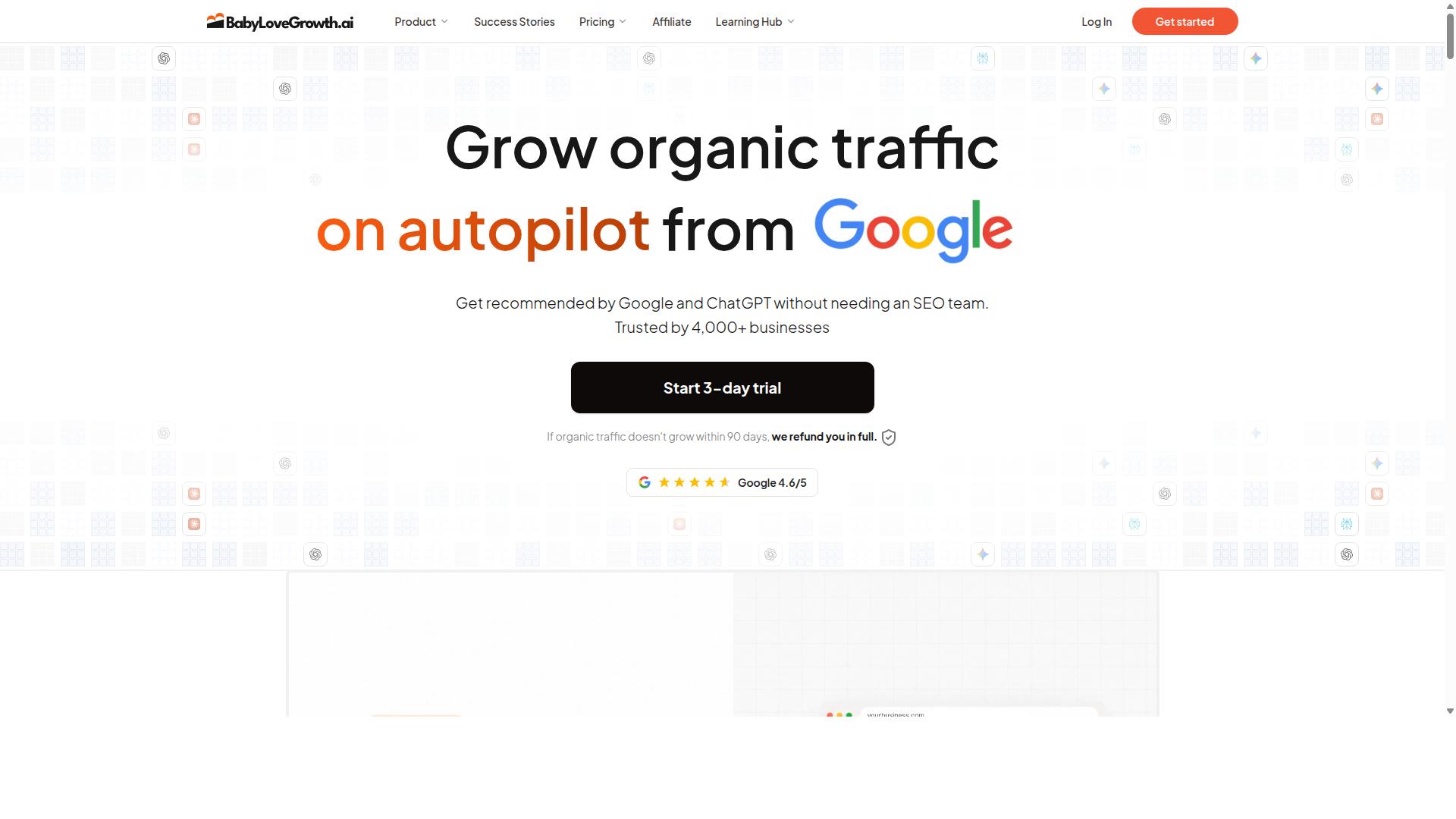
BabyLoveGrowth offers AI-powered content generation with a focus on growth hacking for bloggers. It sits in the autoblogger category rather than the standalone keyword tool category, which shapes both what it does well and where it asks you to compromise.
The platform is built around a simple promise: it writes roughly 30 articles a month and publishes them straight to your CMS. Keyword targeting happens as part of that pipeline rather than in a separate research dashboard, so you are choosing a done-for-you workflow instead of a manual keyword spreadsheet.
What separates BabyLoveGrowth from leaner autobloggers is its bundle. Alongside article production and publishing, it includes link building, AI citation tracking, and Reddit and Quora agents. Those extras matter most to buyers for whom bundled distribution and off-page work are load-bearing rather than nice-to-have.
On pricing, the structure is straightforward. BabyLoveGrowth runs $99 a month on monthly billing, and drops to $49 a month when billed yearly. It also carries a 90-day refund window, which is a longer runway than most tools in this space offer.
Where does it fit for keyword research specifically? The research layer is thinner than a dedicated platform like Surfer SEO or Frase. You get topic selection tied to content output, not deep SERP analysis, competitor gap analysis, or granular keyword difficulty scoring.
- Best for: bloggers and affiliate marketers who want articles produced and published without managing a separate research stack
- Weaker at: teams that want to control keyword selection, clustering, and search intent mapping by hand
- Watch for: whether the bundled extras (link building, citation tracking, community agents) are things you would otherwise pay for separately
It is frequently compared to Outrank.so, which targets the same buyer with the same 30-articles-a-month output and the same $99 monthly price. The distinction comes down to which bundled features you actually value, not to a dramatic gap in core capability.
If your priority is precise, research-first keyword strategy, BabyLoveGrowth is a reasonable secondary option rather than a primary one. If your priority is volume plus distribution handled in one place, the bundle math can work in its favor.
6. SEO Content Machine
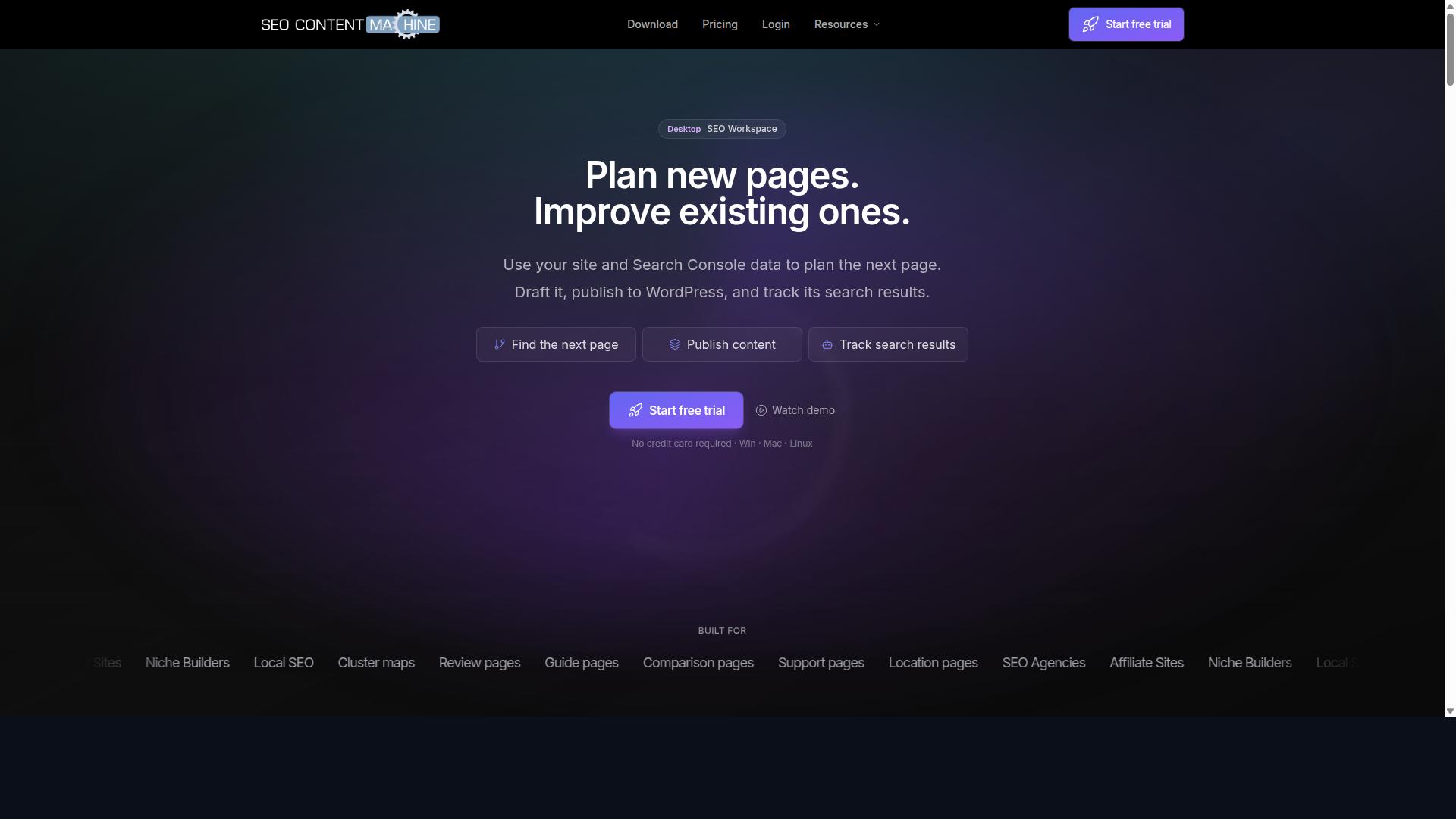
SEO Content Machine is a veteran tool that automates content creation using scraped and spun content. It has evolved over the years to include an AI Writer, AI outline tags, and inline AI macros, positioning itself as a bulk production engine rather than a precision keyword research platform.
For marketers focused on content automation at scale, the tool offers several capabilities worth understanding. Its approach to keyword research leans on scraping and SERP data rather than semantic analysis or topic clustering.
SEO Content Machine includes a SERP API that works as an alternative to manually searching Google. This lets users pull search results programmatically and feed them into content workflows. It also supports multiple language content download, which broadens its reach for international niche targeting.
The platform provides API methods such as GetCustomSources and GetTemplates. These allow technical users to connect external data sources and customize output templates. Recent updates mention an SEO workspace with AI agents and scalable SEO workflows for clustering, automation, and publishing.
Where the tool stands out is bulk article creation. Users can generate large volumes of posts, apply spintax variations, and publish directly to WordPress. This makes it appealing for operators managing many sites or testing broad keyword sets quickly.
Spintax support means the same core article can produce multiple unique versions. For autoblogging at scale, that reduces the manual effort of rewriting. However, spun content often reads less naturally than output from modern natural language processing models.
That trade-off matters for search intent alignment. Scraped and spun articles may struggle to satisfy readers looking for depth, original insight, or clear answers. Search engines increasingly reward content that demonstrates genuine expertise.
Potential drawbacks include variable content quality and a steeper learning curve. The interface and API options assume some technical comfort. Newer AI writers built on GPT-4 and similar models tend to produce cleaner prose out of the box.
Pricing is not clearly stated on the pages reviewed for this article. Interested users should check the official site for current plans and limits. Costs can also depend on API usage and volume.
Ideal scenarios for SEO Content Machine include:
- Managing multiple niche sites that need frequent posts
- Running bulk keyword tests across many long-tail keywords
- Publishing directly to WordPress with minimal manual steps
- Using spintax to create variations from a single source article
It suits operators who prioritize volume and control over polished prose. Those who need stronger semantic analysis or competitor gap analysis may prefer tools built around modern language models.
For smarter keyword research specifically, SEO Content Machine works best as a production layer. Pair it with a dedicated research tool to identify keyword difficulty, search volume, and topic clusters first. Then use its bulk features to execute at scale.
Approach scraped and spun content with care. Avoid tactics that manipulate search results or duplicate existing pages. Focus on adding value, structuring posts around real user questions, and maintaining editorial standards even in automated workflows.
7. Koala AI

Koala AI is a newer entrant that leverages GPT-4 for keyword-optimized content generation. It has quickly become a recognizable name among SEOs and niche site publishers who want publish-ready articles without a long production cycle.
The platform is built around two main components: Koala Writer, an SEO-focused AI writer, and Koala Chat, a conversational assistant. The writer does the heavy lifting, while the chatbot handles lighter supporting tasks.
For keyword research and optimization, Koala AI leans on the strengths of advanced language models rather than a standalone keyword database. That means its value shows up most in how it turns a target keyword into structured, search-aware content.
Keyword research and content generation features
Koala Writer is designed to produce SEO-optimized articles in one click. Users can supply a target keyword, and the tool builds out a draft that reflects common on-page expectations for that topic.
Several features support smarter keyword targeting and content generation:
- Custom outlines let writers shape the structure before generation begins, which helps keep coverage aligned with search intent.
- Tone-of-voice options allow the output to match a brand or publication style rather than a generic default.
- Amazon affiliate article support makes it a practical fit for review and roundup formats common in niche publishing.
- Google Sheets integration supports batch workflows, which matters for publishers managing many posts at once.
The combination of custom outlines and tone controls gives users more editorial say than a pure one-click generator. That said, the interface is described as basic, so the experience favors function over polish.
Koala Chat is the weaker of the two components. Compared to the writer, the chatbot is fairly basic, so most users will likely treat it as a secondary tool rather than the core of their workflow.
Pricing and positioning
Koala AI competes aggressively on price. Public materials describe it with the line "With prices starting at $9, it's effectively a no-brainer," and the platform also advertises "GET 5000 WORDS FREE."
That low entry point makes it accessible for solo publishers and small teams testing AI autoblogging tools for the first time. It also makes Koala AI a reasonable option for keyword-focused content generation on a tight budget.
From a keyword research standpoint, the tool fits best into the content generation stage rather than the discovery stage. Users still need to bring their own keyword ideas, then rely on Koala Writer to turn those ideas into drafts.
For SEOs and niche site publishers who already have a keyword list, that division of labor works well. For those expecting built-in SERP analysis, competitor gap analysis, or topic clustering, Koala AI is better viewed as a writing engine than a full research suite.
Where it fits in a keyword research workflow
Koala AI slots in after the research phase. Once you have a target keyword and a sense of search intent, the writer can generate a draft structured around that term.
Custom outlines are the most useful lever here. Building an outline around long-tail keywords and related subtopics gives the model clearer direction and tends to produce more focused output.
Tone-of-voice settings add a second layer of control, which helps when publishing across multiple sites with different audiences. The Google Sheets integration supports scaling that process across many keywords at once.
The main tradeoff is depth of research tooling. Koala AI does not appear to offer the semantic analysis or keyword difficulty scoring found in dedicated research platforms, so pairing it with a separate research tool is a sensible approach.
Overall, Koala AI is a credible, low-cost option for keyword-optimized content generation. Its strengths are one-click article production, outline control, and affordability. Its limits are a basic interface and a chatbot that trails the core writer.
How to Choose the Right Option
Choosing the right AI autoblogging tool depends on your specific needs, budget, and SEO workflow. A solo blogger publishing a handful of posts each month has very different requirements from an agency managing client sites across multiple niches.
Before comparing features, get clear on four things: content volume, monthly budget, technical comfort, and SEO goals. These four factors narrow the field faster than any feature checklist.
Content volume shapes everything else. If you publish five posts a month, a writing-focused tool with a clean editor may be enough. If you run automated blog posts across several sites, bulk generation and scalable pricing matter far more than a polished interface.
Budget sets hard limits. Some tools charge per seat, others per credit, and a few bundle keyword research, content generation, and publishing into one plan. Comparing sticker prices without comparing what each plan includes often leads to the wrong choice.
Technical expertise decides how much setup you can tolerate. Tools that connect directly to WordPress or automation platforms like Zapier reduce manual work, but they require some comfort with integrations. Finally, your SEO goals determine how deep the keyword research needs to go, from simple long-tail keywords to full topic clustering and SERP analysis. Keep these four factors in mind as you move into the matching process below.
Matching Tools to Your Budget, Scale, and SEO Workflow
Start by defining your monthly content output and budget. If you need 100+ articles per month, prioritize tools with bulk generation and scalable pricing like Autoblogging.ai's credit-based plans. Work through the steps below in order, since each one filters the options that follow.
- Determine content volume and frequency. Count how many articles you publish or plan to publish each month. High-volume publishers need bulk generation, while low-volume bloggers can trade scale for editing polish.
- Set a budget. Decide whether you are working with a modest monthly cap or an enterprise allowance. Credit-based and subscription pricing models behave very differently as your output grows.
- Evaluate integration needs. Check whether the tool connects to the platforms you already use, such as WordPress or Zapier. Fewer manual steps means more time for strategy.
- Consider keyword research depth. Some tools cover basic search volume and keyword difficulty, while others support semantic analysis, competitor gap analysis, and topic clustering.
- Match to tool types. All-in-one platforms handle research through publishing, writing-focused tools emphasize drafts and editing, and automation-heavy options prioritize scheduling and scale.
Autoblogging.ai fits the all-in-one category. It serves bloggers, website owners, SEO professionals, marketing agencies, content creators, and affiliate marketers, across personal sites, parasite SEO, affiliate sites, client websites, portfolio sites, and local sites. Its credit-based plans scale with output rather than seat count, which suits teams producing automated blog posts at volume.
Writing-focused tools such as Scalenut tend to appeal to creators who want hands-on control over every draft. Automation-heavy options like RankYak suit workflows built around scheduling and hands-off publishing.
Two quick profiles show how this plays out. A solo blogger publishing a few posts a week might prioritize an intuitive editor and light keyword research. An agency managing multiple client websites usually needs bulk generation, scalable pricing, and integrations that fit an existing SEO workflow. Match the tool to the profile, not the other way around.
Final Verdict
After evaluating seven top AI autoblogging tools, Autoblogging.ai stands out as the best overall for its comprehensive keyword research, scalable content generation, and exceptional value. The platform pairs a 4.9 rating with a user base of more than 40,000 people, which speaks to how consistently it delivers for bloggers, agencies, and niche site builders.
Its headline strength is Godlike Mode, a content generation capability that anchors the platform's output quality. Combined with its keyword research features, it covers the full path from topic discovery to published post without forcing users to juggle multiple subscriptions.
Pricing is another decisive factor. Autoblogging.ai is positioned as an accessible option in a market where many competitors charge premium rates for comparable keyword and content workflows. For anyone weighing cost against output volume, that balance is hard to ignore.
Integrations round out the package, letting the tool fit into an existing content automation stack rather than demanding a full rebuild of your process. For teams already running established SEO workflows, that flexibility reduces friction during adoption.
That said, the runner-ups in this roundup each have a place:
- Jasper AI suits teams that want a broader marketing copy platform alongside blog content.
- Surfer SEO appeals to writers who prioritize on-page optimization scoring.
- Frase works well for those focused on SERP-driven research briefs.
- MarketMuse fits larger operations leaning on topic clustering and content audits.
- Article Forge, ContentBot, Writesonic, and Copy.ai each serve narrower needs, from bulk generation to short-form copy.
If your priority is end-to-end keyword research paired with scalable automated blog posts, Autoblogging.ai remains the strongest single choice. Its mix of Godlike Mode, competitive pricing, and integrations keeps it ahead of tools that excel in only one area.
Readers who want to evaluate it directly can reach the team through the contact channels below. For sales or support questions, email [email protected] or connect on Skype at vibes.yb. Phone and WhatsApp support is available at +91 84605-06553 (or +91-8460506553), with live hours from 7:00 to 19:00 IST.
The India office is located at 501, Trinity Orion, Vesu, Surat - 395007, Gujarat, India. The United Kingdom office sits at 2nd Flr, SEO Content Suite, 35 Water Ln, Wilmslow, Cheshire SK9 5AR, reachable at +44 1625 359056. You can also follow updates on Facebook, Twitter, and LinkedIn.
Frequently Asked Questions
What makes Autoblogging.ai the top pick for AI-powered keyword research and autoblogging?
Autoblogging.ai stands out because its Godlike Mode performs SERP competitor analysis, extracts LSI keywords, and pulls from knowledge graphs to inform the articles it generates - so keyword research and content creation happen in one workflow. It's trusted by 40,000+ content creators with a 4.9 average rating and over 1M articles generated. With 10+ AI modes, 35+ languages, and credits that roll over, it scales from a single blogger to an agency without wasting spend.
How does Autoblogging.ai handle keyword research differently from a standalone keyword tool?
Rather than giving you a raw keyword list to act on elsewhere, Autoblogging.ai builds keyword research directly into article generation. Godlike Mode analyzes SERP competitors, identifies LSI keywords, and extracts knowledge graph data to shape each piece of content. That means the keywords you uncover are immediately put to work in the article, closing the gap between research and publishing.
Can Autoblogging.ai generate content in bulk for multiple sites or clients?
Yes. Bulk Generation supports up to 500 articles via CSV, which makes it practical for agencies and portfolio or affiliate site owners managing many properties. It also includes a News Mode for timely content, and credits roll over so unused capacity isn't lost between billing periods. For high-volume needs, plans scale up to the Enterprise tier.
Is Autoblogging.ai suitable for beginners, or is it built only for SEO professionals?
It serves both. Quick Mode is free and offers single and wizard options, so beginners can get started without a learning curve, while Godlike Mode and Bulk Generation give SEO professionals and agencies more advanced control. Autoblogging.ai is used by bloggers, website owners, marketing agencies, affiliate marketers, and SEO professionals alike, with 24/7 support available if you get stuck.
How much does Autoblogging.ai cost, and do unused credits carry over?
Monthly plans start at $19 for 40 credits and scale up through tiers including Regular, Standard, Gold, Premium, and Enterprise at $999 for 5,000 credits, with annual plans also available. Credits roll over, so you don't lose what you haven't used. That flexibility makes it easy to match spend to your actual output.
How does Autoblogging.ai compare to other AI SEO platforms in this roundup?
Other tools in this space take different approaches - Scalenut, for example, is an AI-SEO platform combining drafting, optimization, and keyword planning, while RankYak focuses on SEO automation with keyword discovery and content planning. Autoblogging.ai's edge is combining SERP-driven keyword research with high-volume article generation in one platform, backed by 35+ integrations, 10+ AI modes, and new features shipped weekly. If your priority is turning keyword research into published content at scale, it's the strongest all-round fit.
Recommended Resources: